Will the Fed unlock Bitcoin's next rally?
Jun 16•7 min read
In this patch of your weekly Dispatch:
- First decision under new Fed chair
- Market-moving macro comes
- SpaceX's Bitcoin goes public
Market cast
BTC shows green in the charts
Bitcoin's technical picture is showing early signs of a shift. On the weekly chart, price has bounced from the 200-period SMA — a key long-term trend indicator, and is now pushing toward the middle Bollinger Band, a volatility indicator that marks the midpoint of the current price range. The RSI and Stochastic oscillators, both momentum indicators, remain at relatively low levels but their signal lines are turning higher — a tentative sign of building bullish momentum. The MACD histogram, a trend and momentum indicator, sits slightly above the zero line, keeping the longer-term structure cautiously constructive.
On the daily chart, the picture is more nuanced. Price is now testing the middle Bollinger Band, which is acting as dynamic resistance at current levels. The RSI has moved into neutral territory and continues to rise, while the Stochastic signal lines are approaching overbought conditions — a reminder that the short-term rebound may need to consolidate before extending further. The MACD histogram has moved into positive territory and is trending higher, offering some near-term encouragement.
Key levels to watch: Support sits at $63,000 and $61,000. To the upside, the first hurdle is the daily middle Bollinger Band as dynamic resistance, followed by the $68,000–$69,000 zone and $71,000 beyond that.
The big idea
Will a new Fed chair support Bitcoin’s recovery?
For months, uncertainty around the U.S.-Iran conflict has weighed on risk assets and capped every Bitcoin recovery attempt. Over the weekend, reports of a ceasefire agreement offered some relief — oil prices fell sharply, Asian equities moved higher, and Bitcoin climbed back above $65,000 for the first time in nearly two weeks. The situation is still developing, with the formal signing expected later this week. But for now, at least, one of the market's more persistent sources of anxiety appears to have eased.
The next focus shifts quickly to Wednesday, when the Federal Reserve delivers its June 17 interest rate decision — the first under new Chair Kevin Warsh. A hold is widely expected, with markets pricing in around a 97% probability of no change. The more consequential question is what the accompanying dot plot and Warsh's press conference reveal about the path ahead. Specifically, whether rate hikes later this year remain a genuine possibility.
The data the Fed is walking in with offers no easy answers. May's CPI came in at 4.2% year-on-year — elevated, but in line with expectations, with core monthly inflation coming in slightly softer than forecast. The labor market paints a similarly nuanced picture: three consecutive months of solid job gains, unemployment holding at 4.3%, yet weekly jobless claims ticked above forecasts last week and there are early signs of strain beneath the surface — long-term unemployment is rising and hiring intentions among small businesses have fallen to a six-year low. The Fed will see a labor market that is neither breaking down nor giving it room to ease. That is the difficult position Warsh inherits on Wednesday.
How Bitcoin responds will depend heavily on tone. If the dot plot suggests inflation is moving back toward target, and that cuts could be possible by late 2026, the market may find the catalyst it has been looking for. A more hawkish signal — higher for longer, or any suggestion of hikes — could undo much of the weekend's recovery and bring $60,000 back into view.
In the meantime, some early signals are worth noting. Standard Chartered believes the cycle low is in at $59,000, pointing to three confirmations: ETF inflows returning, oil prices falling, and Strategy resuming purchases. All three appear to be falling into place — Bitcoin ETFs pulled in $85.8 million on Friday, and Saylor delivered on his word. On-chain, a seller exhaustion signal tracked by Glassnode showed that the market's largest whale cohorts added close to 11,000 BTC on the same day – see more in this week’s data story.
So where does that leave us? One source of uncertainty has eased. Whether the Fed provides another on Wednesday remains to be seen — but the answer may go a long way toward defining where Bitcoin goes.
Ethereum
ETH still in its early days?
ETH's price may be struggling, but the institutional story is quietly accelerating. In a recent CoinDesk interview, Etherealize founder Vivek Raman described Ethereum as "the infrastructure for Wall Street" — and argued that large financial institutions have moved well beyond proof-of-concept, now deploying on public blockchains in production. Tokenized stocks, bonds, real estate, and funds are all expanding beyond stablecoins as the institutional entry point.
The price disconnect, Raman says, comes down to timing. Institutional sales cycles are long, and the full wave of assets has yet to migrate on-chain. The argument is that Ethereum's network effect — built on years of liquidity dominance and institutional deployments — has created the foundation, but the scale of adoption hasn't been reflected in the asset yet. When more tokenized assets settle on Ethereum, the expectation is that the market will reprice ETH's role accordingly, Raman argues. Which means we may simply be early. The infrastructure is there, the institutions are arriving, and ETH's price may just need time to catch up.
Macroeconomic roundup
Macro signals play tug of war
Markets head into the week on the front foot after the Iran peace deal lifted oil prices and risk sentiment. The calendar is packed — two central bank decisions, European inflation prints, and a stream of U.S. data all landing within 72 hours.
Eurozone CPI YoY (Jun 17): Confirms whether the ECB's recent hike is working — any upside surprise adds to the higher-for-longer narrative.
US Retail Sales MoM (Jun 17): A read on consumer spending that feeds directly into the Fed's economic projections released the same day.
UK CPI YoY (Jun 17): A hot print keeps pressure on the Bank of England to stay tight.
BoE Interest Rate Decision (Jun 18): The Bank of England navigates its own balancing act between slowing growth and sticky inflation.
Philadelphia Fed Manufacturing Index (Jun 18): A miss here could further complicate the picture for U.S. economic momentum heading into the summer.
Initial Jobless Claims (Jun 18): Claims have been creeping higher — a reading above 220,000 would add weight to the case for eventual easing.
TradFi trends
The world’s first trillionaire
SpaceX made history last week with the largest IPO ever, raising $75 billion at $135 per share before jumping 19% on its Nasdaq debut — briefly touching $176.50 intraday and closing at $161, pushing its market cap above $2 trillion. Shares continued climbing on Monday pre-market, hovering around $170.
The listing also made Elon Musk the world's first trillionaire. His 42% stake in SpaceX, combined with his Tesla holdings, put his total net worth at $1.11 trillion. SpaceX's business spans reusable rockets, the Starlink satellite network, and long-term ambitions around orbital data centers — a story that analysts say could take two decades to fully play out, but one the market appeared willing to bet on from day one.
The week's most interesting data story
What a whale wants
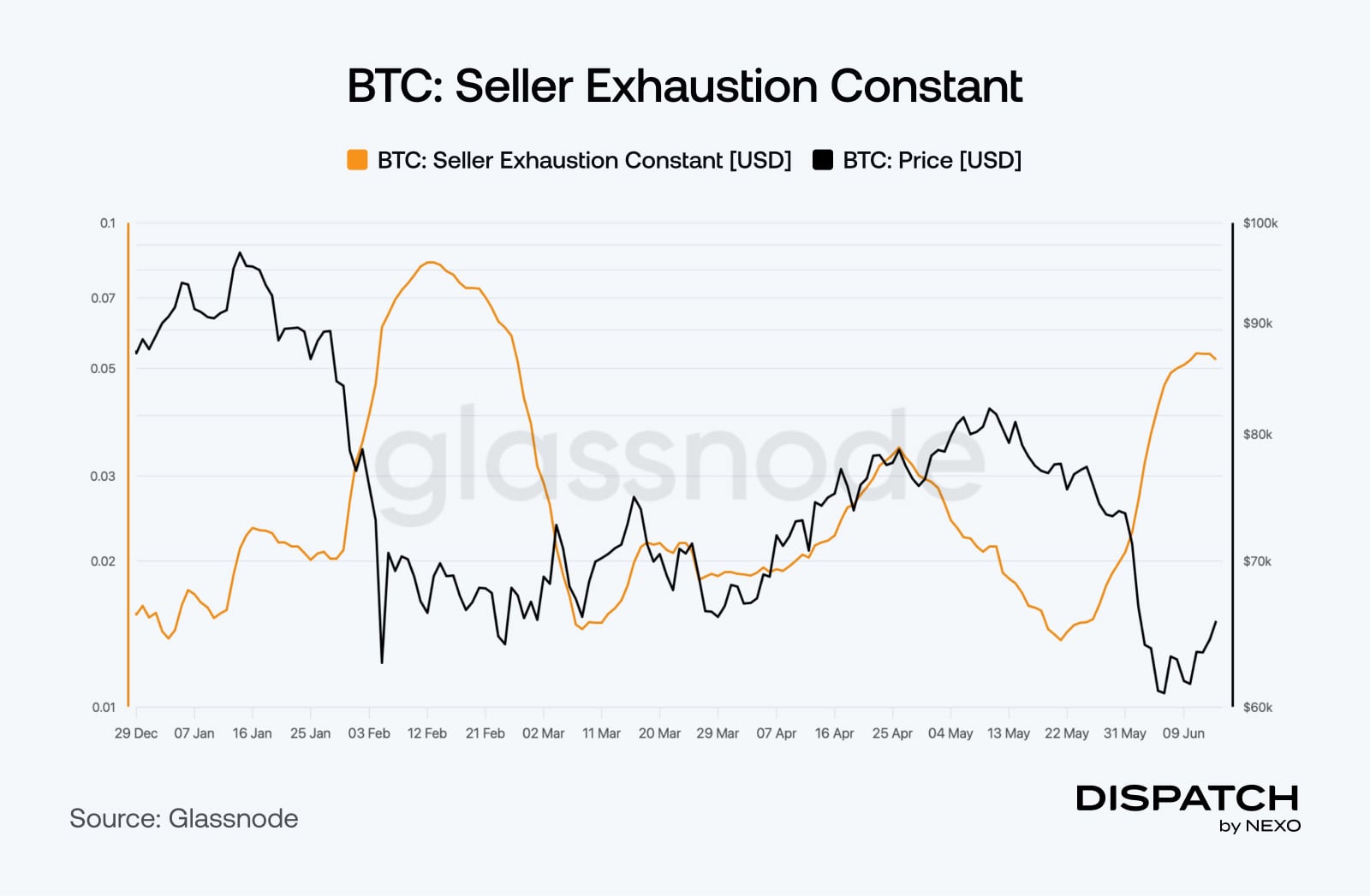
One of the more reliable tools for identifying Bitcoin cycle bottoms is a metric called the Seller Exhaustion Constant — a Glassnode indicator that flags the moment when sellers have largely done their worst, capturing the point at which supply in profit is low, and volatility has compressed. Historically, it has marked the point where there is simply less left to sell.
On June 11, the signal flashed for only the second time in 2026. The last time it appeared, on February 12, Bitcoin went on to rally 24% over the following weeks. What followed this time was telling: two of the largest whale cohorts added close to 11,000 BTC — worth around $700 million — on the exact same day. Bitcoin has since rebounded from its $59,100 low back above $65,000, now testing resistance near $66,600. A sustained move above that level would open the path toward $70,000 and beyond, echoing the trajectory of the last signal. The metric and the market's largest holders are pointing in the same direction.
The numbers
The week’s most interesting numbers
1% — The Bank of Japan raised rates to their highest level since 1995, and Bitcoin shrugged it off.
$2 trillion – U.S. spot Bitcoin ETFs are closing in on $2 trillion in cumulative trading volume, less than two and a half years since launch.
18,712 BTC — The bitcoin position SpaceX brought to public markets via its record IPO this week — the largest bitcoin holding ever attached to a public listing
$100 million – Strategy purchased 1,587 BTC this week, bringing its total holdings to 846,842 BTC.
Hot topic
What the community is discussing
So the bottom is in?
Whales in the dip.
Is it Gold’s turn for a pullback?
Dispatch is a weekly publication by Nexo, designed to help you navigate and take action in the evolving world of digital assets. To share your Dispatch suggestions and comments, email us at [email protected].